
[ad_1]
When the public health crisis first took hold, some people playfully speculated that there would be a spike in births in nine months, as people were “stuck home” with their romantic partners. Such speculation is based on persistent myths about birth spikes occurring nine months after blizzards or major electricity blackouts. As it turns out, those stories tend not to hold up to statistical examination (Udry, 1970). But the COVID-19 crisis is amounting to much more than a temporary stay-at-home order. It is leading to tremendous economic loss, uncertainty, and insecurity. That is why birth rates will tumble.
As economists, we focus on the underlying decisions that drive behaviors and ultimately outcomes, including having children. Our approach to modeling fertility is different than scholars from the medical or reproductive health community, who tend to focus on the mechanical drivers of pregnancy and giving birth, like access to birth control or abortion. These are important, of course, and we have focused on them in our own previous research (Kearney and Levine, 2009, Levine, et al., 1999, and Levine, 2004). But it is important to recognize the critical role that economic conditions play in fertility choices.
Economics matters for birth rates
As any parent will tell you, children come at a cost. They require outlays of money, time, and energy. Certainly, they are also a source of joy and love. In the analytical terms of economic modeling, adults “choose” the quantity of children that maximizes their lifetime well-being subject to the costs associated with childbearing. Such a framework predicts, all else equal, that a higher level of lifetime income leads people to have more children. Biological constraints may prevent some people from achieving their target number of births, or optimal timing. But there is considerable empirical support for the prediction that an increase in income leads to more births, what economists call “a positive income effect.”
Black, Kolesnikova, Sanders, and Taylor (2013) find that marital births in coal-producing areas tracked earnings changes associated with the coal boom and bust during the 1970s and 1980s. Kearney and Wilson (2018) find that the higher incomes that came about from fracking led to increases in both marital and non-marital births in affected counties. Autor, Dorn, and Hanson (2019) show that places that experienced a reduction in employment and earnings – resulting from increased import competition from China – consequently had lower birth rates. Increases in housing wealth also lead to increases in fertility; Dettling and Kearney (2014) and Lovenheim and Mumford (2013) show that increases in house prices lead to increases in births among existing home owners, consistent with a positive wealth or home equity effect, while Dettling and Kearney (2014) further show that increases in house prices lead to reductions in births among renters, consistent with a negative price effect.
Boom and bust – and babies
Apart from the question of how many children to have, parents also face the decision of when to have them. If credit markets are perfect, parents can borrow and save in order to finance the cost of children and optimally choose when to have children. But it is difficult for people who are credit constrained to choose to have a child when their income is low. If money matters for fertility, we would therefore expect to see births move with the business cycle.
There is ample evidence that birth rates are, in fact, pro-cyclical. This is shown, for instance, in the work by Dettling and Kearney (2014) described above. Their analysis of birth rates in metropolitan areas finds that all else equal, a one percentage-point increase in the unemployment rate is associated with a 1.4 percent decrease in birth rates. Schaller (2016) analyzes the relationship between state-level unemployment rates and birth rates, and finds that a one percentage-point increase in state-year unemployment rates is associated with a 0.9 to 2.2 percent decrease in birth rates. Other evidence shows that women whose husbands lose their jobs at some point during their marriage ultimately have fewer children (Lindo, 2010). This suggests that transitory changes in economic conditions lead to changes in birth rates.
If people are simply timing their fertility with the business cycle, then the years after an economic downturn will see a relative increase in birth rates, such that women’s total completed fertility might largely be unchanged. However, to the extent that delayed fertility results in lower total fertility for some women, then the observed reductions in current period births will reflect reductions in the total number of births. Furthermore, if shocks to economic conditions prove to be persistent, then changes in birth rates will be as well. A deeper and longer lasting recession will then mean lower lifetime income for some people, which means that some women will not just delay births, but they will decide to have fewer children.
Recessions mean fewer children
The COVID-19 public health crisis has badly damaged the economy, and the recession is likely to last for many months. The Federal Reserve forecasts that the unemployment rate will still be at 9.3 percent by the end of the year. Barrero, Bloom, and Davis (2020) predict that 42 percent of recent layoffs will be permanent. Though many of these workers will eventually find new employment, research has shown that recession-related job loss leads to persistent, large negative effects on lifetime earnings (Davis and von Wachter, 2017).
An analysis of the Great Recession leads us to predict that women will have many fewer babies in the short term, and for some of them, a lower total number of children over their lifetimes. This is consistent with the evidence described above. The Great Recession led to a large decline in birth rates, after a period of relative stability. In 2007, the birth rate was 69.1 births per 1,000 women ages 15 to 44; in 2012, the rate was 63.0 births per 1,000 women. That nine percent drop meant roughly 400,000 fewer births.
State-level comparisons provide a more direct link between an economic downswing and birth rates. States in which the recession was more severe experienced greater declines in birth rates, according to our analysis of Vital Statistics birth data from the National Center for Health Statistics, population data from the U.S. Bureau of the Census, and state unemployment rates from the Bureau of Labor Statistics from 2003 to 2018. States in which the recession was most severe experienced larger drops in births. In this simple analysis, we find that a one percentage point increase in unemployment reduces the birth rate by 1.4 percent. (That is an unweighted estimate; weighting the observations yields an estimated impact of -1.2 percent).
Over a longer time period, from 2003 and 2018, we find that that a one percentage point increase in the state unemployment rate led to a 0.9 percent reduction in the birth rate. This estimate comes from a more formal econometric analysis, using a regression model estimating the natural log of the birth rate as a function of the unemployment rate in the preceding year, controlling for state and year fixed effects. A more detailed study could include other potentially relevant factors, such as expanded access to long-acting reversible contraceptives (LARCS), better access to health insurance, and others. We expect however that including these factors would yield a larger estimate, since our estimated effect is on the lower end of those found in the more detailed econometric studies described above.
The Spanish Flu and Births
We have emphasized the role of weaker economic conditions in driving a future decline in births, but we hasten to acknowledge the public health aspect. The 1918 Spanish Flu provides an obvious comparison; and it generated a large decline in births.
Here we show the monthly trend in the death rate due to influenza and pneumonia (the main causes of death attributed to Spanish Flu), along with the aggregate birth rate (births per 1,000 population) for those states reporting Vital Statistics data at that time (21 states participated in 1918). Birth rates are backdated by nine months to approximate the month of conception:
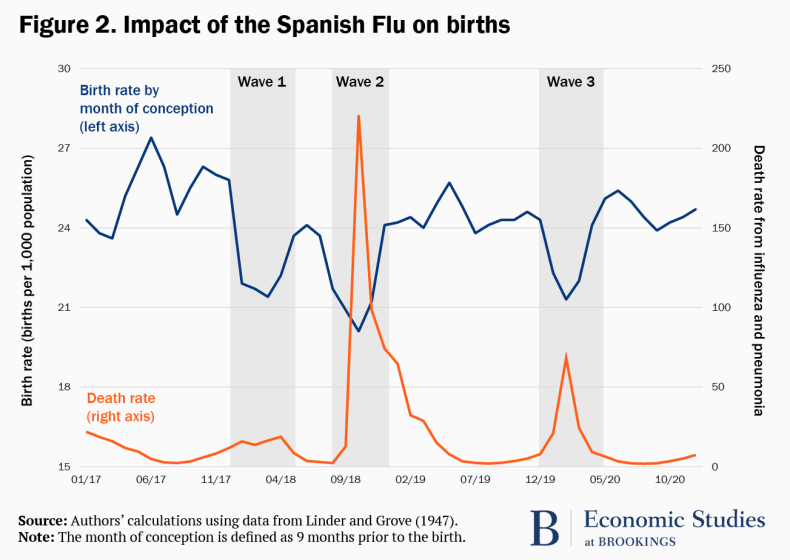
Large spikes in mortality were matched by large declines in births. Determining causation is always difficult, but the precision with which the spikes match strongly suggest this was a causal impact. As a rough approximation, the steady state monthly birth rate during this period was 24 births per 1,000 population. Each spike in the Spanish Flu epidemic led the birth rate to fall roughly 21 births per 1,000 population. This represents a 12.5 percent decline. Note that when the death rate dropped again, birth rates returned to normal levels, but did not “overshoot,” implying fewer births overall.
In drawing lessons from the Spanish Flu for the COVID-19 pandemic, we note both similarities and differences. The drop in births that resulted from the Spanish flu was likely due to the uncertainty and anxiety that a public health crisis can generate, which could affect people’s desire to give birth, and also biologically affect pregnancy and birth outcomes. That could be true during this crisis as well. But, unlike what we’re experiencing today, the economy contracted only modestly at the time of the Spanish Flu because the ongoing war effort supported manufacturing (Benmelech and Frydman, 2020). This suggests COVID-19 could have a bigger impact, since the public health crisis has hit the economy, too. Furthermore, women today have access to much more effective forms of contraception. On the other hand, a much larger share of the Spanish Flu deaths was concentrated on those in their childbearing years (Simonsen, et al., 1998).
Birth rates are impacted by high-mortality events more generally, as Lyman Stone points out. He underlines the established fact that “high-mortality events as diverse as famines, earthquakes, heatwaves, and disease all have very predictable effects on reducing births nine months later.” Stone shows estimates from “death spike” events including Hurricane Maria, Hurricane Katrina, and the 2015 Ebola outbreaks in Liberia, Sierra Leone, and Guinea. Although this is consistent with our hypothesis, the key mechanisms are different. Stone’s hypothesis focuses on the mechanical relationship between mortality and illness among people of childbearing age and subsequent fertility. COVID-19 is not having a large impact on the mortality of people of childbearing age. Only 1% of COVID-19 deaths reported so far in the U.S. are among the under-35s. But the current crisis is also one that we will endure for quite some time, unlike the one-time, discrete occurrences that characterize these other high mortality events.
How big will the Covid-19 baby bust be?
What are the likely implications of the COVID-19 episode for fertility? The monthly unemployment rate jumped from 3.5 percent to 14.7 percent in April and to 13.3 percent in May. Note that the BLS also indicate that technical issues in collecting these data likely mean that the actual unemployment rates in those months were likely 5 and 3 percentage points higher, respectively. That would bring them to about 19.7 and 16.3 percent. Although it is difficult to forecast the 2020 annual unemployment rate, assuming a 7 to 10 percentage-point jump to 10.6 to 13.6 percent seems reasonable. Based on the findings presented above, this economic shock alone implies a 7 to 10 percent drop in births next year. With 3.8 million births occurring in 2019, that would amount to a decline of between 266,000 and 380,000 births in 2020.
On top of the economic impact, there will likely be a further decline in births as a direct result of the public health crisis and the uncertainty and anxiety it creates, and perhaps to some extent, social distancing. Our analysis of the Spanish Flu indicated a 15 percent decline in annual births in a pandemic that was not accompanied by a major recession. And this occurred during a period in which no modern contraception existed to easily regulated fertility.
Combining these two effects, we could see a drop of perhaps 300,000 to 500,000 births in the U.S. Additional reductions in births may be seen if the labor market remains weak beyond 2020. The circumstances in which we now find ourselves are likely to be long-lasting and will lead to a permanent loss of income for many people. We expect that many of these births will not just be delayed – but will never happen. There will be a COVID-19 baby bust. That will be yet another cost of this terrible episode.
Acknowledgements: The authors thank Taylor Landon for excellent research assistance.
The authors did not receive financial support from any firm or person for this article or from any firm or person with a financial or political interest in this article. They are currently not an officer, director, or board member of any organization with an interest in this article.
[ad_2]
Source link